
CJA: India’s Movement for Conscious Citizens & Empowered Communities
Published by: CitizenJournalismAcademy.com Series: Master Article Series | Article 01 of 06 Category: Foundation | Vision & Mission Tags: #CitizenJournalism #ViksitBharat #NationFirst #CommunityEmpowerment #CityJournalist
“The most powerful weapon in the hands of the oppressor is the mind of the oppressed. Give every citizen a pen, a camera, and a purpose — and you give them the power to build a nation.”
~ Inspired by the Spirit of Viksit Bharat
A Nation of 1.4 Billion Voices. How Many Are Being Heard?
India is not a country. India is a civilisation — ancient, complex, and extraordinarily alive. With 1.4 billion citizens, 4,000 towns, 6 lakh villages, and thousands of local governing bodies, India is the world’s largest, most vibrant democracy. And yet, at this very moment, in every city, in every ward, in every neighbourhood — stories of transformation, struggle, courage, and community are going untold.
A pothole on a school road has been ignored for three years. A government park has been encroached upon, and residents don’t know their right to reclaim it. A local entrepreneur has built a model for zero-waste living but nobody beyond her street knows her name. A group of young men has cleaned a lake every Sunday for two years — but their work never made it to a single newspaper.
These are not small stories. These are the stories of India becoming.
And almost none of them are being reported.
This is the problem that City Journalism Academy was born to solve.
The Information Gap That Is Holding India Back
Before we talk about solutions, we must be honest about the problem — and the problem is significant.
India has over 100,000 registered publications and hundreds of TV news channels. Yet the coverage of hyper-local, ground-level civic issues remains desperately thin. Why? Because mainstream media is built for scale, not depth. It is designed to reach millions, not to serve one neighbourhood. Advertising economics push news towards controversy, celebrity, and conflict — not towards the story of a residents’ welfare association that just convinced their municipal corporation to build a playground.
The result is a dangerous information vacuum at the most critical level of democracy: the local level.
When citizens don’t know what is happening in their own locality, they cannot participate. When they cannot participate, they cannot hold systems accountable. When systems are not accountable, development slows, resources are misused, and communities stagnate. The chain from information to empowerment to development is broken — and it breaks right at the local level.
Consider these realities:
Most Indian citizens do not know the name of their local councillor or ward member. Fewer still know what budget has been allocated for their area’s development, or whether it has been spent correctly. Issues like illegal construction, water contamination, missing streetlights, or drainage failures fester for months — not because the system cannot respond, but because no one has formally documented, reported, and amplified the issue in a structured, credible, and persistent manner.
This is not a failure of the system alone. This is a failure of informed, organised citizen voice.
And that is precisely what Citizen Journalism Academy exists to create.
The Vision: A Conscious Citizen in Every Colony. A City Journalist in Every Ward.
The vision of Citizen Journalism Academy is both simple and revolutionary:
Every Conscious Citizen in India has the right, the ability, and the responsibility to become the journalist of their own community.
We envision a India where – in every city, town, and tehsil – there are trained, empowered, ethically grounded City Journalists who observe, document, report, and amplify the truth of their local reality. Not to create noise. Not to spread fear or outrage. But to shine a light on what is working, what is broken, what needs to be celebrated, and what needs to be fixed.
A Viksit Bharat, a Developed India is not built in Parliament alone. It is built street by street, colony by colony, community by community. And that building process needs witnesses. It needs chroniclers. It needs City Journalists.
The vision is not to replace professional journalists. The vision is to build a vast, ground-level network of civic reporters who cover the stories that no media house will chase because these stories are too local, too quiet, and too slow for the 24-hour news cycle. But they are exactly the stories that determine whether a locality grows or decays, whether its citizens are empowered or helpless, whether democracy functions at its most essential level.
The Mission: Train, Equip, Connect, and Empower
City Journalism Academy’s mission operates on four pillars:
Train : To provide every interested citizen with a structured, practical, and inspiring curriculum in citizen journalism. Not journalism school. Not technical jargon. Real skills for real people: how to identify a story, how to verify facts, how to write clearly, how to photograph effectively, how to publish responsibly, how to engage the community around a civic issue.
Equip : To give every City Journalist the tools, templates, frameworks, and digital platforms they need to report effectively. From story templates to social media guides, from interview techniques to RTI (Right to Information) filing processes — every City Journalist will have a practical toolkit ready to deploy.
Connect : To build a nationwide network of City Journalists who support, inspire, and amplify each other’s work. Journalism is most powerful when it is collective. A single voice reporting a drainage problem may be ignored. A hundred trained City Journalists across twenty cities reporting drainage failures, coordinated, consistent, evidence-based becomes a civic movement that governments must respond to.
Empower : To remind every citizen that they are not just a voter or a taxpayer. They are a stakeholder in the development of their city. They carry rights guaranteed by the Constitution, the right to information, the right to expression, the right to peaceful assembly and civic participation. Citizen Journalism is the active exercise of these rights in service of community growth.
What is a City Journalist?
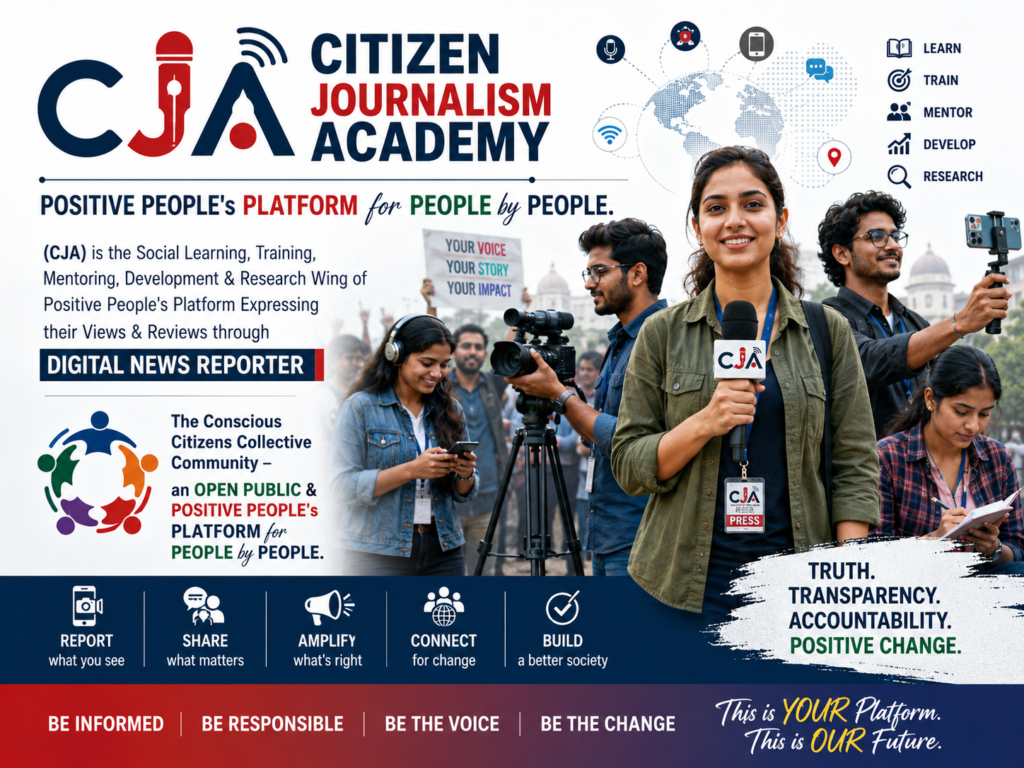
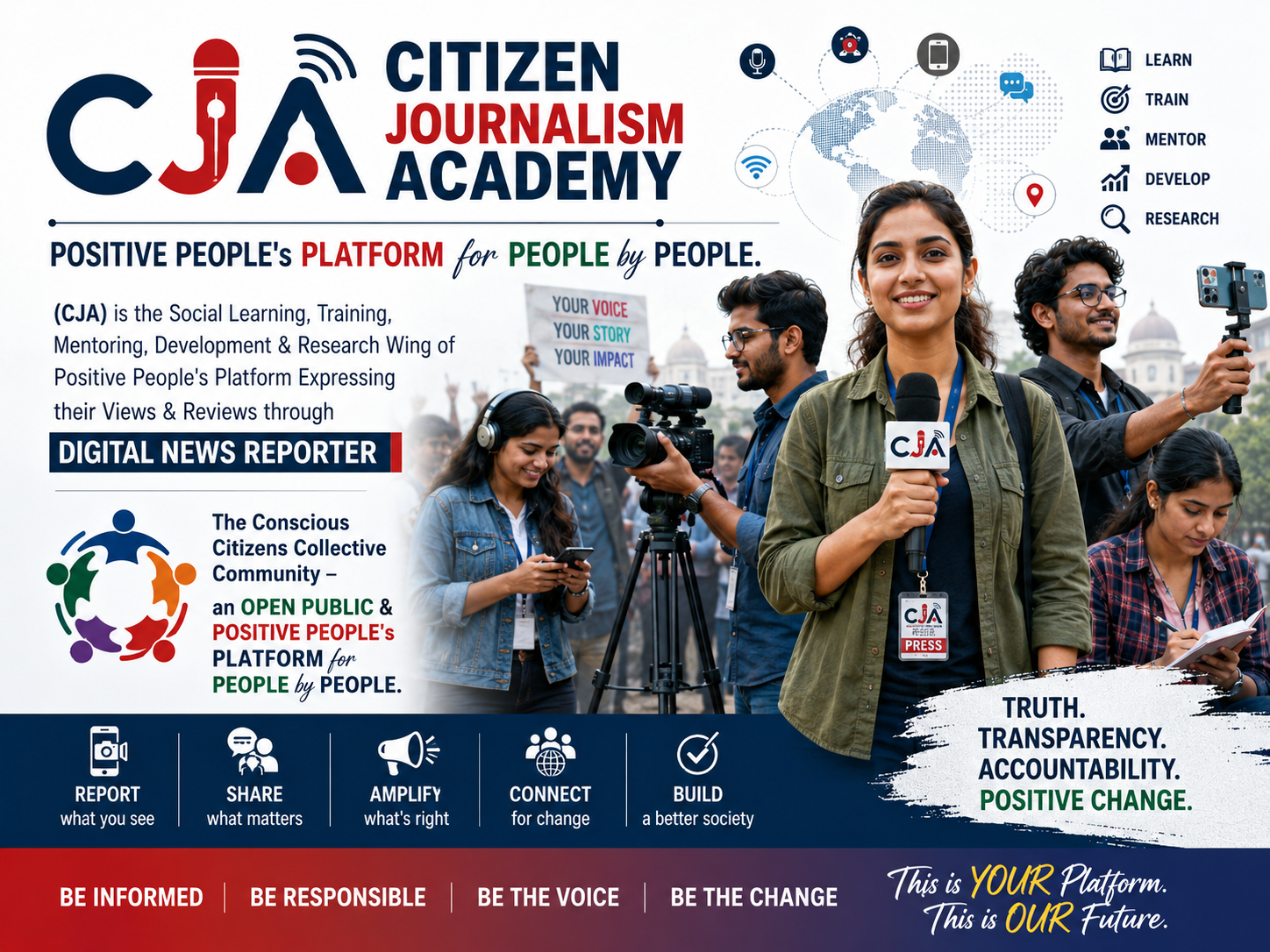
A City Journalist is not a trained professional with a press card. A City Journalist is a conscious, responsible, community-committed citizen who has chosen to use the tools of journalism – observation, documentation, verification, storytelling, and publication – in service of their neighbourhood and their nation.
A City Journalist is a teacher who notices that the school compound wall is crumbling and files a report with photographs, a timeline of complaints, and the names of the responsible authorities – before a child gets hurt.
A City Journalist is a homemaker who discovers that the municipal water supply in her area is contaminated, gathers evidence, talks to affected families, and publishes a community alert that forces immediate action.
A City Journalist is a young professional who attends his first ward committee meeting, takes structured notes, and publishes a clear, fair summary so that the 10,000 residents who couldn’t attend can know what was decided in their name.
A City Journalist is a retired government officer who uses decades of understanding of bureaucratic systems to explain, in plain language, what the new local development plan means for residents – and which voices were missing from the consultation process.
Each of these people already exists in your city. City Journalism Academy’s job is to find them, train them, inspire them, and connect them into a movement.
The Solution: A Movement Built on Three Cs
City Journalism Academy is built on a model we call the Three Cs of Citizen Empowerment:
Consciousness: Awakening citizens to the reality of their civic rights, the power of information, and their personal stake in local development. You cannot report what you don’t see. You cannot advocate for what you don’t understand. Consciousness comes first.
Competence: Giving citizens the actual skills to report, write, publish, and organise effectively. Consciousness without competence becomes frustration. When citizens know what is wrong but don’t know how to act, energy turns to cynicism. Competence converts awareness into action.
Community: Building the network, the support system, and the collective identity that sustains individual effort and multiplies impact. A lone City Journalist can move a mountain – slowly. A community of City Journalists can move mountains together, faster, and with far greater credibility and reach.
Citizen Journalism Academy is the institution that builds all three.
Why Now? Why This Moment in India’s History?
We are living through a defining decade. India has committed to becoming a Viksit Bharat, a fully developed nation by 2047. This is not merely an economic aspiration. It is a civilisational project that demands the full, informed, and active participation of every citizen.
But development cannot be a top-down broadcast. It must be a bottom-up conversation. It must include the voices of those most affected by local decisions – the residents, the small business owners, the women’s self-help groups, the senior citizens, the youth. These voices must be heard not just at election time, but continuously, credibly, and constructively.
Furthermore, we are living through a revolution in communication technology. Every Indian with a smartphone is already a potential broadcaster. WhatsApp groups, Facebook pages, and YouTube channels have democratised distribution in ways that were unimaginable twenty years ago. The tools already exist. What is missing is the training, the ethics, the structure, and the collective purpose to use those tools for community good rather than misinformation and outrage.
City Journalism Academy occupies exactly this intersection of citizen readiness, technological access, national ambition, and the urgent need for ground-level, trustworthy local information.
The moment has never been more right. India has never needed this more.
The Call to Action: India Is Waiting for Your Report
If you are reading this, you are already a potential City Journalist. You already care about your community. You already notice what is wrong and what could be better. You already have opinions, observations, and stories that deserve to be heard.
City Journalism Academy invites you to take the next step.
Become a subscriber and begin receiving the tools, training, and inspiration to become a conscious civic voice. Become a learner and join the structured curriculum that will transform your awareness into competence. Become a City Journalist and join a growing movement of citizens who are choosing to build Viksit Bharat from the ground up, one story at a time.
Your city has problems that need to be documented. Your city has heroes that need to be celebrated. Your city has decisions being made right now that need more eyes, more questions, and more voices.
You are that voice.
City Journalism Academy is not a media organisation. It is not a political movement. It is not a protest platform. It is a training ground, a community, and a national mission, to make every Indian citizen a conscious, capable, courageous participant in the democracy they inherited and the Viksit Bharat they are building.
The pen is the most powerful tool of a free people. We are putting it in your hands.
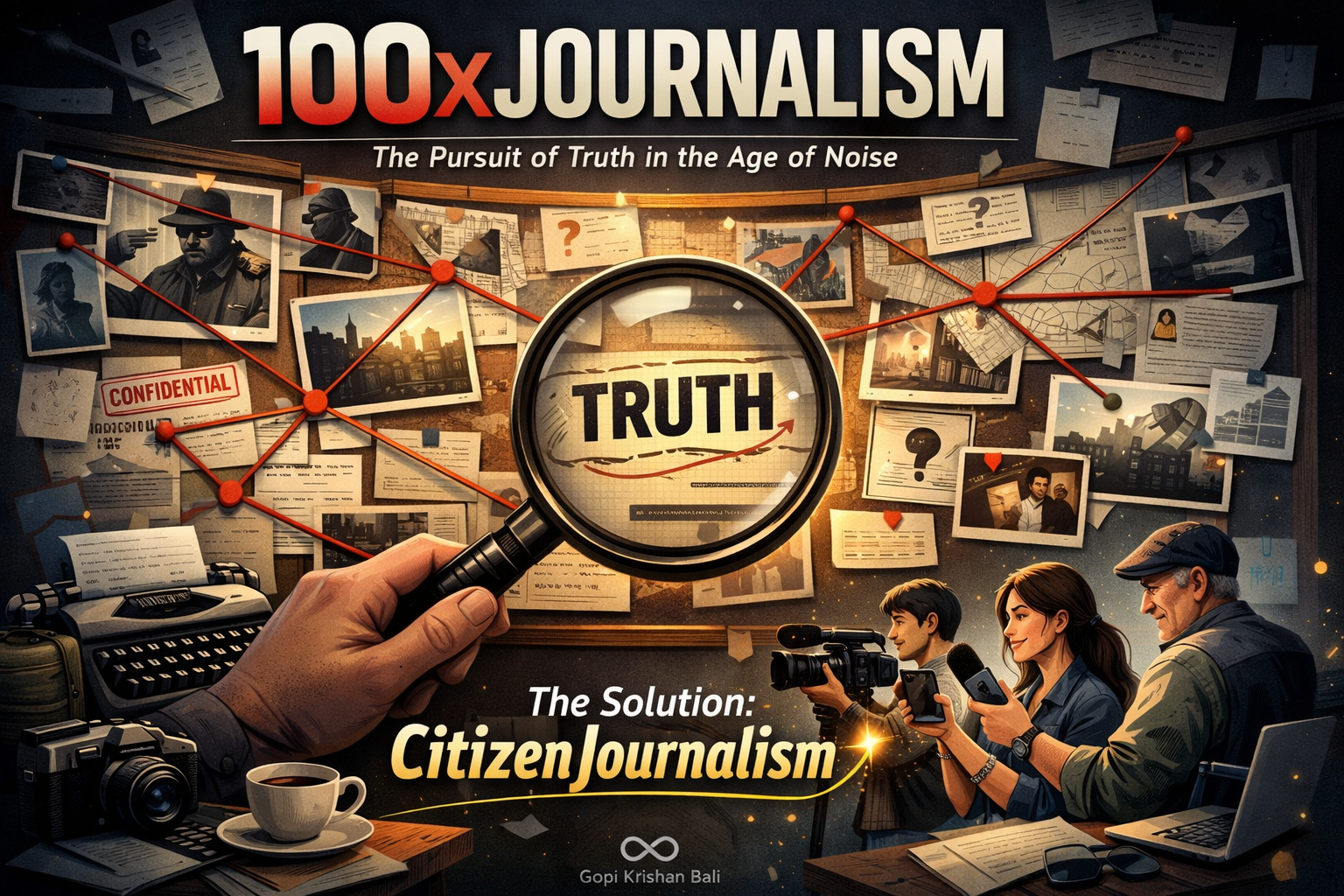
Welcome to Citizen Journalism Academy. Report. Empower. Build. #NationFirst #ViksitBharat #100xBHARAT
About Citizen Journalism Academy
Citizen Journalism Academy (CityizenournalismAcademy.com) is a social initiative dedicated to training and empowering citizens across India to become effective, ethical, and impactful City Journalists. Through digital content, structured courses, community building, and a national network of civic reporters, the Academy is building the grassroots information infrastructure that Viksit Bharat demands.
Join the movement: CitizenJournalismAcademy.com Follow us: #CityJournalismAcademy | #CitizenJournalism | #ViksitBharat | #NationFirst
Article 01 of the Master Article Series | Next: Article 02 — The Power of Citizen Journalism in the Digital Age
© Citizen Journalism Academy | CitizenJournalismAcademy.com | Reproduce with attribution for community use