
Why Your Voice Matters More Than Ever
A Deep Dive into the Role, Impact, and Future of Journalism in India
Introduction: The Story That Changed Everything
Let me tell you about Gauri. On September 5, 2017, a journalist walked out of her home in Bengaluru. She never made it back inside. Three bullets ended her life, but they couldn’t silence the questions she’d been asking, the stories she’d been telling, or the impact she’d been making.
Gauri was a journalist. Not the kind who sits in air-conditioned newsrooms reading teleprompters. The kind who asked uncomfortable questions. Who spoke truth to power. Who gave voice to the voiceless.
Why am I starting with this story?
Because it answers the most fundamental question anyone considering journalism must ask: Does journalism really matter anymore?
The answer, written in Gauri’s blood and in the work of thousands of journalists across India, is a resounding YES.
But the real question isn’t whether journalism matters. It’s whether you understand just how much power you could wield as a journalist and whether you’re ready to use it.
WHAT IS JOURNALISM, REALLY?
Beyond the Textbook Definition
Open any journalism textbook, and you’ll find variations of the same dry definition:
“Journalism is the activity of gathering, assessing, creating, and presenting news and information.”
Technically correct. Completely uninspiring.
Let me give you a different definition – one that captures what journalism really is:
Journalism is the art of finding out what someone doesn’t want you to know, understanding why it matters, and telling everyone about it in a way they can’t ignore.
Still not convinced? Let’s break down what journalism actually does:
The Five Fundamental Functions of Journalism
1. The Watchdog (Holding Power Accountable)
Imagine a society where the powerful could do whatever they wanted with no one watching. No one asking questions. No one demanding answers.
That’s not imagination, that’s what happens when journalism dies.
Real Example: Remember the 2G spectrum scam? ₹1.76 lakh crore of public money potentially lost. Who uncovered it? Journalists. Who kept the pressure on until it became impossible to ignore? Journalists. Who ensured the story didn’t die when powerful people wanted it to? Journalists.
One journalist with a notebook, a phone, and persistence changed the trajectory of Indian politics.
2. The Translator (Making Complexity Understandable)
The government announces a new farm law. What does it actually mean for a farmer in Punjab?
The Reserve Bank changes interest rates. How does that affect your father’s small business loan?
A new education policy is introduced. Will it help or hurt your sister’s chances of getting into college?
Journalists translate complexity into clarity. They bridge the gap between policy and people, between data and decisions, between experts and everyone else.
Real Example: During COVID-19, millions of Indians were terrified and confused. What were the symptoms? How did it spread? Were masks really necessary? Were vaccines safe?
Good journalism cut through misinformation, panic, and political spin to deliver facts that saved lives. Bad journalism (or lack of journalism) in some regions cost lives.
3. The Spotlight (Illuminating the Invisible)
Some of the most important stories in India are about people and issues that no one talks about.
Manual scavengers who clean sewers with their bare hands, risking their lives for ₹200 a day.
Dalit students who excel academically but face discrimination that textbooks never mention.
Tribal communities displaced by development projects that will never benefit them.
These aren’t “nobody cares” stories. They’re “nobody knows” stories. Until a journalist shines a light.
Real Example: The 2019 Rural Village rape case. A teenage girl was raped. Then threatened. Then her father was killed in police custody. The case would have been buried, another “didn’t happen” story in rural India.
But journalists refused to let it die. They kept reporting. Kept asking questions. Kept the spotlight burning until the nation couldn’t look away. Justice followed the light.
4. The Connector (Building Communities)
Good journalism doesn’t just inform, it reforms system, it connects to Transform Communities
It shows the farmer in Tamil Nadu that they’re facing the same problems as the farmer in Punjab.
It helps the working mother in Mumbai realize she’s not alone in her struggles, millions face the same childcare crisis.
It connects the aspirations of students in Patna with opportunities in Bangalore.
Journalism creates the shared understanding that makes collective action possible.
5. The Recorder (Writing History’s First Draft)
Fifty years from now, when people want to understand what life was like in India in 2026, where will they look?
They’ll look at journalism.
Every news article, every photograph, every investigative report, every feature story, they’re all pieces of the historical record. You’re not just reporting today’s news. You’re writing tomorrow’s history.
Real Example: Want to understand the Emergency of 1975-77? Read the journalism from that time, what was published, what was censored, what was risked, what was lost.
Want to understand the Indian Ocean tsunami of 2004? Journalism preserved not just the facts, but the faces, the voices, the humanity of that tragedy.
SO ARE YOU READY TO INFORM | REFORM | TRANSFORM ??
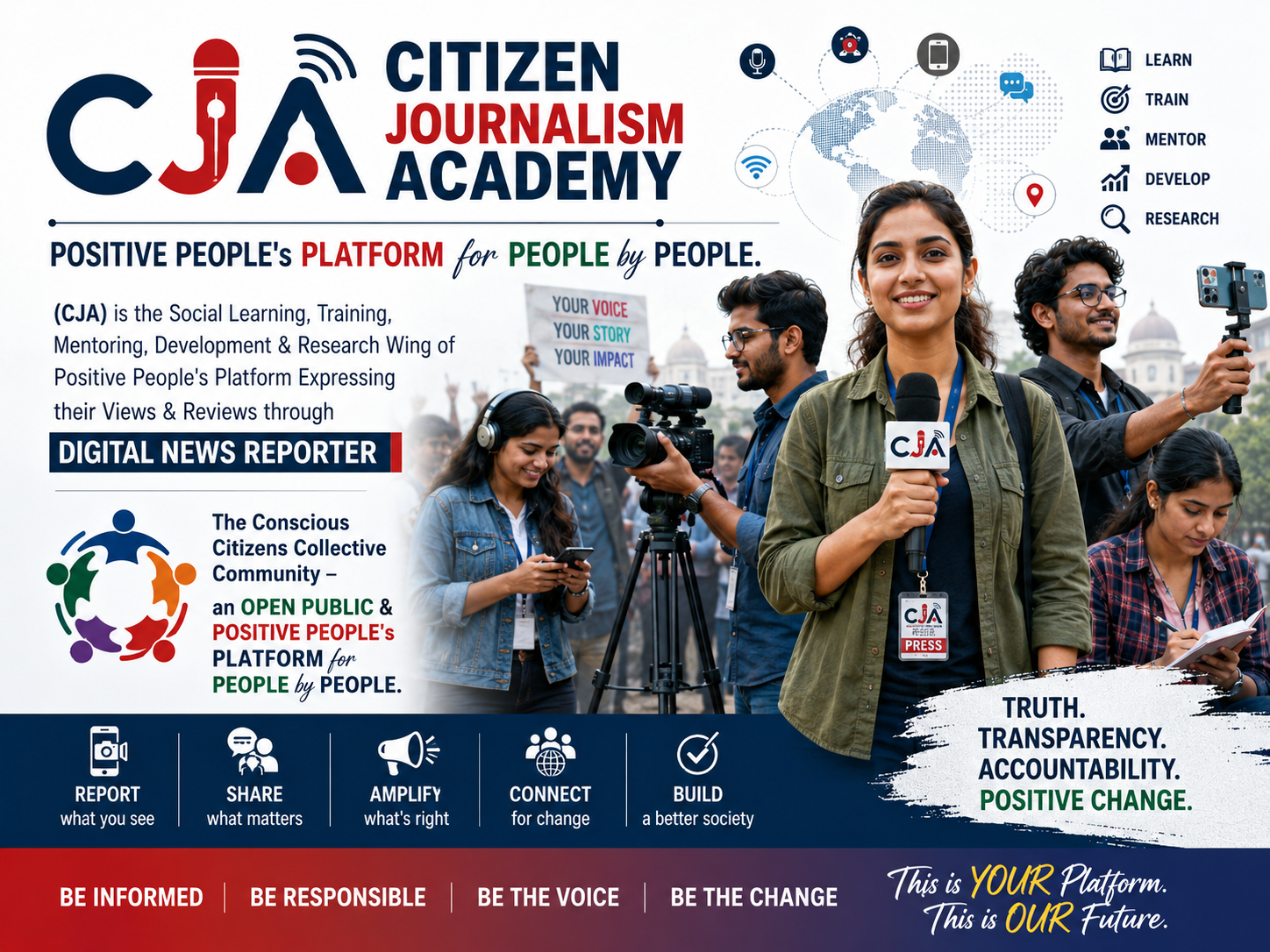
BE A CONSCIOUS CITIZEN JOURNALIST | JOIN the CJA COURSE